


Your grandfather never talked about it. Your father pretends it doesn't exist. But that walnut-sized gland sitting quietly below your bladder? It's literally a ticking time bomb that could change everything about your life.
I'm talking about your prostate. And if you're a Nigerian man over 40, what I'm about to share might be the most important thing you read this year.
The Silent Killer Nobody Wants to Discuss
Picture this: You're at a family gathering in Lagos. Uncle Emeka suddenly excuses himself from the conversation - again. It's the fourth time in an hour. Everyone pretends not to notice, but you know what's happening. He's struggling with something that affects 7 out of 10 Nigerian men over 50, yet nobody dares mention it at the dinner table.
Here's what's really happening inside Uncle Emeka's body: His prostate has swollen to twice its normal size, squeezing his urethra (the tube that carries pee) like a python strangling its prey. Every bathroom trip feels like trying to squeeze water through a pinched hose. And the worst part? Prostate cancer is the most common noncutaneous cancer affecting men, claiming more lives than we care to admit.
But wait - before you close this article thinking "that's old people's problem," let me hit you with this reality check: In Nigeria, some 100,000 new cases of cancer occur yearly, with high case fatality ratio. And prostate cancer? It's right up there at the top of the list.
What Your Local Baba Told You Was Actually Right
Remember when your grandmother insisted you eat those bitter leaves she grew behind the house? Or when the local herbalist talked about certain seeds having "special powers" for men?
Turns out, they weren't just speaking "village medicine." Science is finally catching up to what our ancestors knew all along.
Let me share something fascinating: Researchers have scientifically validated more natural products including the seeds of pawpaw and watermelon that could be successfully used to prevent and treat prostate problems without unpleasant side effects.
Yes, you read that right. Those black pawpaw seeds you've been throwing away? They might be more valuable than gold for your prostate health.
The Hidden Treasure in Your Kitchen Trash
Here's where things get really interesting. A groundbreaking study by Nigerian scientists at Covenant University discovered something that'll make you think twice before throwing away those pawpaw seeds.
The black seeds from papaya may have a potential to reduce growth of prostate cells; however, consumption of white seeds should be avoided as they may stimulate pre-existing prostate cancer.
Let that sink in for a moment. The black seeds - the ones that look burnt and unappetizing - are the ones with the power. But those white, fresh-looking seeds? They could actually make things worse.
It's like nature's own twisted joke, isn't it? The ugly duckling turns out to be the swan.
The Bitter Truth About Bitter Leaf
Now, let's talk about bitter leaf (Vernonia amygdalina). That vegetable your mother forced you to eat, claiming it "cleans the system"? Well, mama was onto something big.
A Nigerian born Professor of Biology, Ernest Izevbigie has patented a formula made from bitter leaf (Vernonia amygdalina). This bitter leaf-based formula is a proven anti-diabetic and anti-cancer formula in laboratory and clinical trials.
But here's the kicker - it's not just any bitter leaf preparation. The way you prepare it matters. Traditional methods of squeezing out all the bitterness? You might be washing away the very compounds that protect your prostate.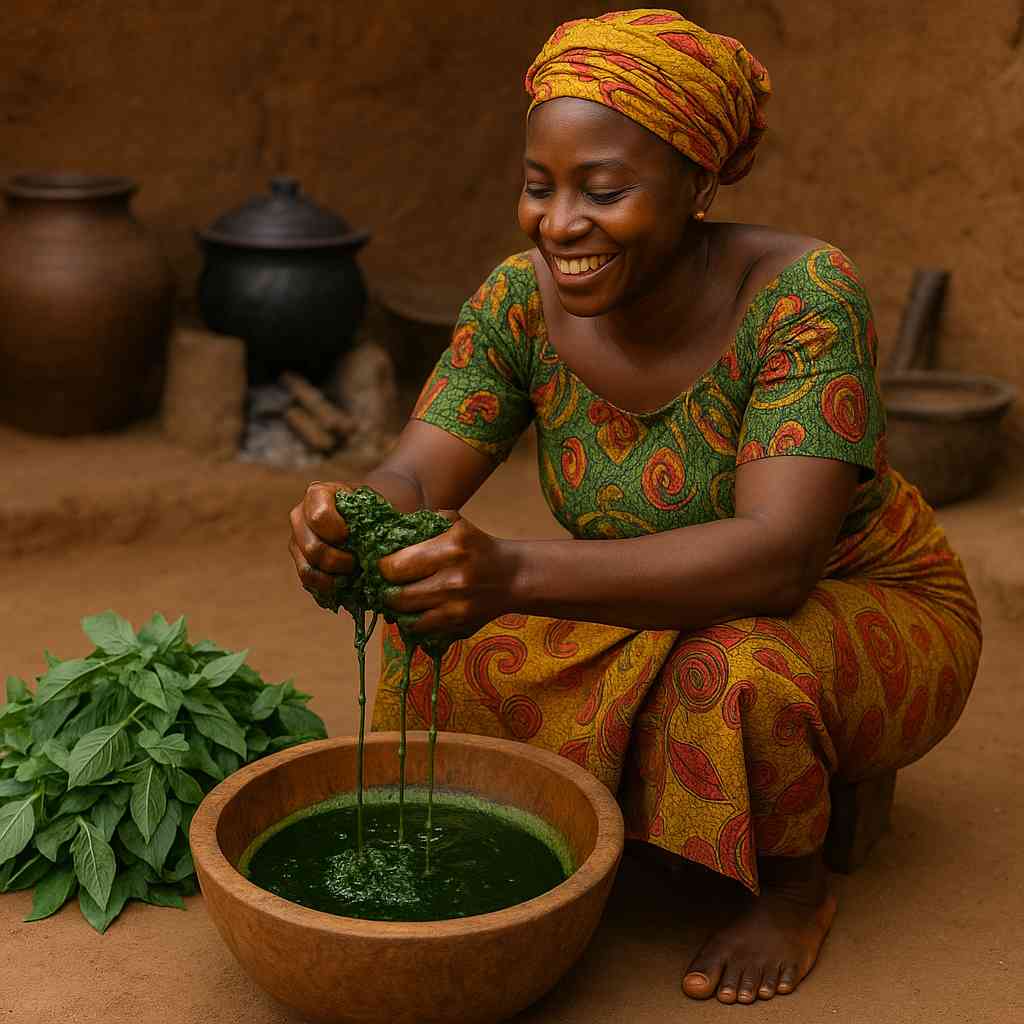
Bitter leaf is a proven anti-diabetic and anti-cancer formula. Make sure to prepare it well.
The Tomato Revolution You Never Saw Coming
Hold onto your seats because this next part will blow your mind. You know how Nigerians love their tomato stew? How we can't imagine eating rice without that rich, red sauce?
Well, it turns out we've been accidentally protecting our prostates all along.
Cooked tomatoes provide the body with more lycopene than uncooked tomatoes, a substance that can help reduce the chances of an enlarged prostate by up to 35%.
But wait, there's more. A study in Brazil found that people who regularly ate 50 grams of raw tomatoes per day for a period of 10 weeks had their risk of an enlarged prostate reduced by approximately 10%. However, for those who ate cooked tomatoes, such as in tomato sauce, tomato puree, and on pizzas containing tomatoes, their risk was reduced by up to 35%.
Think about it - every time your wife spent hours cooking down those tomatoes for Sunday rice, she wasn't just making food tastier. She was literally cooking up medicine for your prostate.
The Watermelon Secret That Changes Everything
Remember those hot afternoons in December when nothing beats a cold slice of watermelon? Well, your body was craving more than just refreshment.
Consuming tomatoes, watermelon and other foods containing lycopene – a naturally occurring phytochemical that gives red or pink fruits and vegetables their characteristic color – may protect against prostate cancer.
But here's what nobody tells you: it's not just about eating watermelon. It's about eating the RIGHT parts. Those white parts near the rind that most people throw away? They contain compounds that specifically target prostate health.
In fact, traditional healers in Southern Nigeria have been using watermelon seed tea for generations to treat "man problems." Now science confirms they were right all along.
The Shocking Truth About Your Sex Life
Okay, let's address the elephant in the room. Or should I say, the activity in the bedroom?
You've probably heard all sorts of myths about sex and prostate health. Some say too much is bad. Others say too little causes problems. So what's the truth?
Brace yourself: Men who averaged 4.6–7 ejaculations a week were 36% less likely to be diagnosed with prostate cancer before the age of 70 than men who ejaculated less than 2.3 times a week on average.
And it gets better. The 2016 study found that ejaculating more than 20 times per month reduced prostate cancer risk by about 20% compared to ejaculating only four to seven times per month.
I know what you're thinking - "Doctor's prescription: more action in the bedroom?" Well, sort of. But before you get too excited, remember this is about overall health, not just one aspect.
A healthy middle-aged Nigerian couple enjoying a romantic dinner with prostate-healthy foods visible on the table - tomato stew, watermelon slices, and vegetable soup.
The Village Medicine That Beat Big Pharma
Let me tell you about Dr. Mathew Origbo from Delta State. This British-trained surveyor turned herbalist created something that made the medical establishment sit up and take notice.
Procin-X and Celloid-S, Nigerian-made drugs, have shown great promise in relieving the symptoms of prostate enlargement, preventing prostate cancer. These preparations use four local plants that grow right in our backyard:
- Boerhavia spp (Hogweed) - That weed you call "Etiponla" in Yoruba or "Guma" in Hausa
- Setaria spp (Foxtail grass) - Known as "Jembe" in Igbo, this common grass you see everywhere
- Platosma spp - The aromatic herb your grandmother calls "Efirin" (though different from scent leaf)
- Alchornea spp (Christmas bush) - "Ewe Ipa" in Yoruba or "Bambami" in Hausa
The Lagos University Teaching Hospital tested these remedies and found something remarkable: PC appear to be effective and in the management of the symptoms of BPH. The positive effects of PC on erectile function may however give them an advantage over the A1B and 5ARI drugs while the reduction in PSA may also give it a role in chemoprevention of prostate cancer.
Translation? These local herbs not only shrink the prostate but also improve bedroom performance. Try getting that from your expensive imported drugs!
The Pepper Soup Ingredient That Could Save Your Life
Here's something that'll make you appreciate your next bowl of pepper soup even more. African pepper or Guinea pepper, Xylopia aethiopica... could be used to stop the spread and development of prostate and breast cancers.
That distinctive taste in your pepper soup? It's not just flavoring - it's medicine. Our ancestors didn't just stumble upon these ingredients by accident. They knew what they were doing.
But like everything else, moderation is key. Too much of anything, even good things, can cause problems.
The Foods You Need to Run From (Like They're Chasing You with Cutlass)
Now for the bad news. Some foods are basically poison for your prostate. And sadly, many of them are becoming more common in Nigerian diets as we become more "westernized."
Over consumption of red meats, such as beef, pork and lamb, can increase the risk of an enlarged prostate and prostate cancer, especially when those meats are grilled, barbecued, smoked or cooked over coals.
Yes, I'm talking about your beloved suya. That smoky, spicy meat you can't resist? Your prostate is begging you to resist it.
And it's not just meat. Over consumption of milk products, such as butter and cheese, can place you at risk of an enlarged prostate.
I know, I know. This is starting to sound like everything enjoyable is bad for you. But stay with me - there's hope.
The 7-Day Prostate Rescue Plan
Here's a practical plan that combines traditional wisdom with modern science. Follow this for just one week and feel the difference:
Monday: Start your day with bitter leaf juice (don't squeeze out all the bitterness). Lunch includes tomato stew with fish. Snack on watermelon.
Tuesday: Pawpaw with black seeds for breakfast (yes, eat those seeds!). Vegetable soup with ugwu for dinner.
Wednesday: Green tea in the morning. Beans porridge for lunch (those legumes are prostate-friendly).
Thursday: Repeat Monday's menu but add pumpkin seeds as an evening snack.
Friday: Fish pepper soup for dinner (with real African pepper).
Saturday: Tomato-based jollof rice (go heavy on the tomatoes).
Sunday: Reward yourself - but skip the suya. Grilled fish is your friend.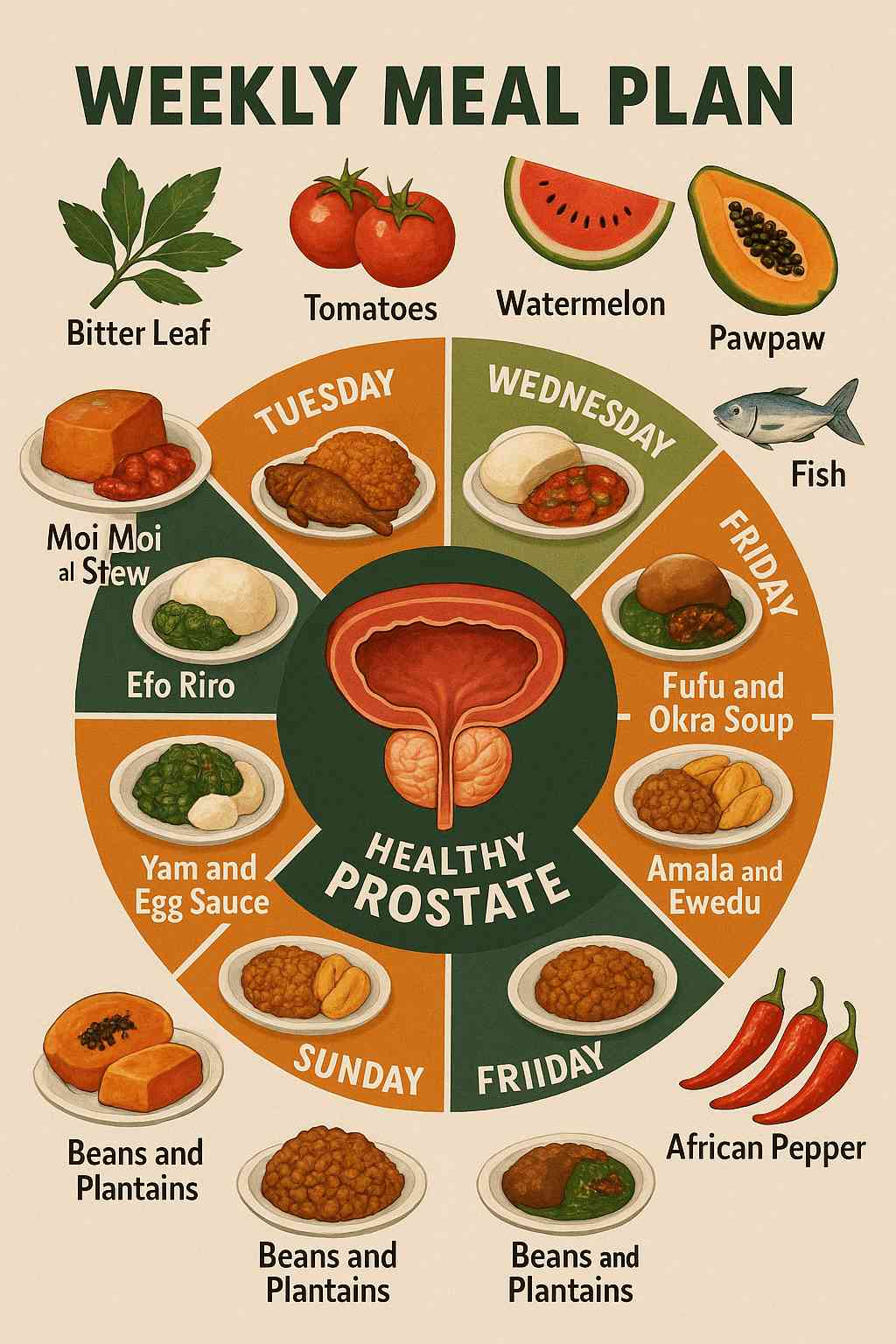
A weekly meal plan with traditional Nigerian foods for a healthy prostate.
The Science Behind Grandma's Wisdom
You might be wondering - how did our ancestors know all this without laboratories and clinical trials?
Simple. They observed. They experimented. They passed down what worked.
Plant families that were used more in treating prostate cancer were:
- Apocynaceae (Dogbane family) - includes "Asofeyeje" (Rauvolfia vomitoria) that your herbalist swears by
- Fabaceae (Bean family) - yes, your regular beans, groundnuts, and "Ata lilo" (Tetrapleura tetraptera)
- Asteraceae (Sunflower family) - includes bitter leaf and "Ewuro" (Vernonia amygdalina)
- Cucurbitaceae (Gourd family) - your ugwu, watermelon, and cucumber
- Bignoniaceae - includes the Kigelia africana ("Pandoro" in Yoruba, the sausage tree)
- Lamiaceae (Mint family) - includes scent leaf ("Nchuanwu" in Igbo, "Efirin" in Yoruba)
These aren't random plants - they're specifically the families that contain the most potent anti-cancer compounds.
Modern research is just confirming what traditional healers knew through centuries of trial and error.
The Warning Signs You Can't Afford to Ignore
Let's get real for a moment. If you're experiencing any of these symptoms, your prostate is screaming for help:
- Getting up more than twice at night to pee
- Feeling like your bladder never fully empties
- Weak stream (like trying to water plants with a blocked hose)
- Starting and stopping while peeing
- Pushing or straining to start
- Dribbling after you think you're done
Don't be like Uncle Emeka who suffered in silence until it was almost too late. These symptoms aren't "normal aging" - they're warning signs.
The Million Naira Question: Does It Really Work?
I know what you're thinking. "If bitter leaf and pawpaw seeds are so powerful, why isn't everyone cured?"
Fair question. Here's the truth: The late Minister of Science, Technology and Innovation, Dr. Ogbonnaya Onu, had announced that Nigeria achieved over 90 per cent success in development of herbal cures for prostate and breast cancers.
90 percent success rate. Let that sink in.
But here's the catch - you have to be consistent. You can't eat bitter leaf once and expect miracles. This is about lifestyle change, not magic bullets.
The Exercise Secret Nobody Talks About
Here's something that might surprise you: Men who walked at a "normal to brisk pace" for 90 minutes during the week had a 46 per cent lower risk of dying from any cause.
Just 90 minutes a week. That's less than 15 minutes a day. You spend more time scrolling through WhatsApp!
And for the runners out there: Men who ran faster than 4.5 meters per second had a 32 per cent less risk of an enlarged prostate than the men who ran less than three metres per second.
Movement is medicine. Our ancestors walked everywhere. Now we drive to buy bread from the shop two streets away. No wonder our prostates are rebelling.
A brisk morning walk is a good medicine for your prostate and overall health.
The Combinations That Multiply Your Protection
Here's where it gets really powerful. When you combine certain foods, their protective effects don't just add up - they multiply.
Tomatoes + Olive oil = Supercharged lycopene absorption Bitter leaf + Pawpaw seeds = Enhanced anti-cancer activity Watermelon + Green tea = Antioxidant powerhouse
It's like having the Avengers of prostate protection assembled in your kitchen.
Your Prostate, Your Choice
Look, I get it. Change is hard. Giving up suya feels like betrayal of your Nigerian heritage. Eating bitter leaf regularly sounds like punishment.
But ask yourself this: What's harder - changing your diet or dealing with prostate cancer? What's more expensive - buying watermelon or chemotherapy?
The choice is yours. But remember, Prostate cancer is the second most common cause of cancer-related death among men.
You can become a statistic, or you can become a success story. The power is literally on your plate.
The Bottom Line That Could Save Your Life
Your prostate doesn't have to be a time bomb. With the right foods, the right lifestyle, and yes, the right amount of bedroom activity, you can keep that walnut-sized gland happy and healthy.
Start today. Not tomorrow. Not next week. Today.
Eat that bitter leaf. Snack on those pawpaw seeds. Make love to your wife more often (doctor's orders!).
And let me be crystal clear about that last point - I said YOUR WIFE. Not your side chick. Not that girl from the club. Not your three girlfriends. YOUR. WIFE.
Why? Because running around town thinking you're "helping your prostate" while collecting STIs like Pokemon cards is like trying to put out fire with petrol. You want to protect your prostate, not give it more problems!
Some of you will twist this information and tell your wife you need a second wife "for health reasons." Brother, that's not how it works. One faithful relationship gives you all the prostate protection you need. Adding more partners just adds more problems - infections, drama, and a different kind of swelling that antibiotics can't fix.
Take that evening walk.
Because at the end of the day, the best treatment isn't in some expensive hospital - it's growing in your backyard, sold in your local market, and waiting in your kitchen.
Your ancestors knew it. Science confirms it. Now you know it too.
The question is: What are you going to do about it?
NOTE: While these natural remedies are powerful, always consult with healthcare providers for proper medical advice. This article combines traditional wisdom with scientific research but isn't a replacement for professional medical care.




Be the first to show love! 🚀
Start something amazing - your support inspires creators!